
AI Business Automation Tools Changing the Way Companies Operate sets the stage for this enthralling narrative, offering readers a glimpse into a story that is rich in detail and brimming with originality from the outset.
As we delve deeper into the realm of AI business automation tools, we uncover a world where efficiency meets innovation, revolutionizing the very core of how companies operate in today's dynamic landscape.
Overview of AI Business Automation Tools
AI business automation tools refer to software applications that leverage artificial intelligence and machine learning algorithms to automate various business processes. These tools are designed to streamline repetitive tasks, improve efficiency, and enhance decision-making within an organization.
Examples of Popular AI Tools for Business Automation
- Chatbots: AI-powered chatbots can interact with customers, answer queries, and provide assistance, reducing the need for human intervention in customer service.
- RPA (Robotic Process Automation): RPA tools can automate rule-based tasks such as data entry, invoice processing, and report generation, freeing up employees to focus on more strategic activities.
- Predictive Analytics: AI tools for predictive analytics can analyze data trends and patterns to forecast outcomes, helping businesses make informed decisions and optimize their operations.
Benefits of Implementing AI Automation Tools
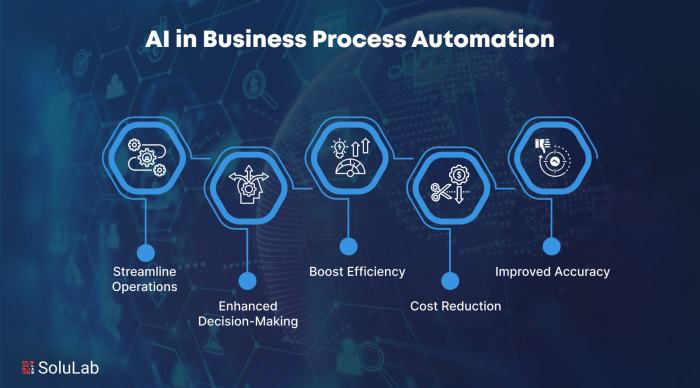
- Increased Efficiency: AI automation tools can perform tasks faster and more accurately than humans, leading to improved productivity and reduced errors.
- Cost Savings: By automating repetitive tasks, companies can save on operational costs associated with manual labor and reduce the risk of human error.
- Enhanced Decision-making: AI tools can analyze vast amounts of data in real-time, providing actionable insights that enable better decision-making and strategic planning.
- Improved Customer Experience: Automation tools like chatbots can enhance customer service by providing instant responses and personalized interactions, leading to higher customer satisfaction.
Impact of AI Business Automation Tools on Operational Efficiency
AI business automation tools play a crucial role in enhancing operational efficiency within organizations by streamlining processes and improving productivity. These tools leverage artificial intelligence to automate repetitive tasks and optimize workflows, allowing companies to operate more efficiently and effectively.
Automating Routine Tasks
- AI automation tools can automate routine tasks such as data entry, document processing, and report generation, freeing up employees to focus on more strategic activities.
- By automating these repetitive tasks, organizations can reduce human error, improve accuracy, and speed up processes, leading to increased operational efficiency.
Streamlining Workflows
- AI automation tools streamline workflows by identifying bottlenecks, optimizing processes, and ensuring tasks are completed in a timely manner.
- These tools can analyze data, predict outcomes, and make recommendations to help organizations make informed decisions and streamline their operations.
Improving Productivity
- AI automation tools boost productivity by enabling employees to focus on high-value tasks that require human judgment and creativity, while repetitive tasks are handled automatically.
- By improving efficiency and reducing manual intervention, these tools allow organizations to accomplish more in less time, leading to increased productivity and business growth.
Integration of AI Business Automation Tools in Different Industries
AI business automation tools have revolutionized the way companies operate across various industries. Let's explore how different sectors are leveraging AI tools to streamline their operations and drive efficiency.
Retail Industry
In the retail sector, AI automation tools are being used to enhance customer experiences, optimize inventory management, and personalize marketing strategies. For example, AI-powered chatbots are helping retailers provide instant customer support, while predictive analytics is enabling them to forecast demand accurately.
Healthcare Industry
AI automation tools are transforming the healthcare industry by improving patient care, diagnosis accuracy, and operational efficiency
Manufacturing Industry
In the manufacturing sector, AI automation tools are optimizing production processes, predictive maintenance, and supply chain management. Robotics and automation systems driven by AI algorithms are enhancing productivity and reducing downtime, leading to cost savings and increased output.
Financial Services Industry
AI automation tools are revolutionizing the financial services industry by automating repetitive tasks, detecting fraud, and personalizing customer interactions. Chatbots are assisting customers with account inquiries, while machine learning algorithms are analyzing vast amounts of data to identify suspicious transactions.
Future Trends in AI Business Automation Tools
AI business automation tools are constantly evolving to meet the changing needs of businesses and industries. As technology advances, new trends are emerging that are reshaping the way companies operate and compete in the market. Let's take a look at some of the future trends in AI business automation tools and their potential impact on businesses.
AI-Driven Decision-Making
AI-driven decision-making is becoming increasingly prevalent in businesses as organizations look to leverage data and analytics to make more informed decisions. By using AI algorithms to analyze large datasets and identify patterns, businesses can streamline decision-making processes and improve overall efficiency.
This trend is expected to continue growing as companies seek to gain a competitive edge through data-driven decision-making.
Predictive Analytics
Predictive analytics is another key trend in AI business automation tools that is revolutionizing the way companies forecast trends and make business decisions. By using advanced algorithms and machine learning techniques, businesses can analyze historical data to predict future outcomes and trends.
This enables companies to anticipate market changes, optimize operations, and make proactive decisions to stay ahead of the competition.
Cognitive Automation
Cognitive automation is a cutting-edge trend in AI business automation tools that combines AI technologies with human-like cognitive abilities to automate complex tasks. By leveraging natural language processing, machine learning, and other cognitive technologies, businesses can automate tasks that traditionally required human intervention.
This trend is expected to drive significant advancements in process automation, customer service, and decision-making capabilities, ultimately enhancing operational efficiency and productivity.
Conclusive Thoughts
In conclusion, the impact of AI business automation tools on companies is profound, reshaping traditional practices and paving the way for a future where automation and intelligence converge seamlessly. As businesses continue to embrace these tools, the possibilities for growth and efficiency are limitless, heralding a new era of operational excellence and competitiveness.
User Queries
What are some benefits of implementing AI automation tools in company operations?
Implementing AI automation tools can lead to increased efficiency, reduced errors, cost savings, and enhanced decision-making capabilities.
Which industries have successfully integrated AI tools for automation?
Industries such as healthcare, finance, manufacturing, and retail have shown successful integration of AI tools for automation.
What are some future trends in AI business automation tools?
Future trends include AI-driven decision-making, predictive analytics, cognitive automation, and the continued evolution of AI technology for business operations.